


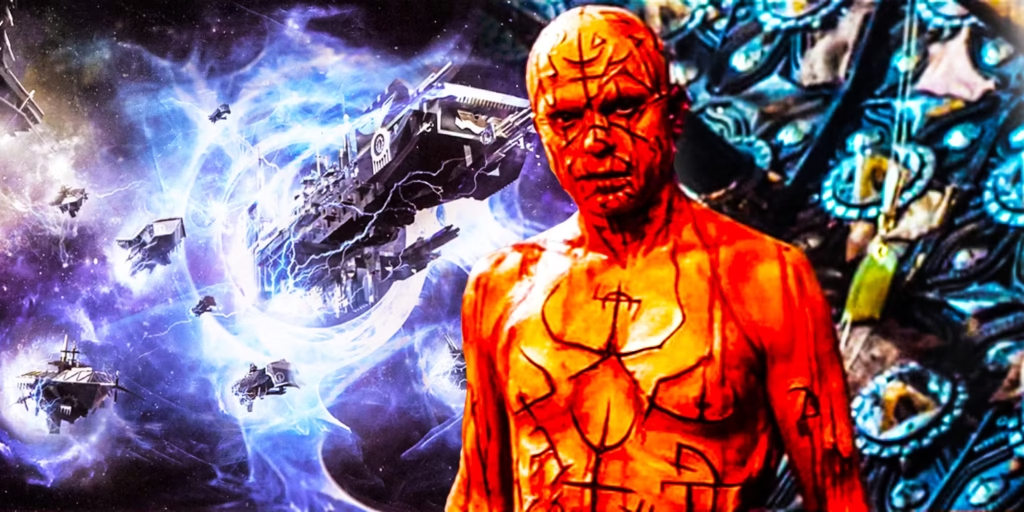
One of sci-fi’s most compelling fan theories claims that Paul W.S. Anderson’s grimdark horror masterpiece is secretly set in the Warhammer 40,000 universe — and the evidence is overwhelming.
What Is the Event Horizon Warhammer 40K Theory?
Released in 1997, Event Horizon is a sci-fi horror film directed by Paul W.S. Anderson and written by Philip Eisner. It follows the crew of a rescue vessel sent to investigate the mysterious reappearance of the experimental starship Event Horizon, which vanished years earlier during its first test voyage. What the crew discovers is something far worse than a simple accident: the ship traveled through a dimension of pure chaos, madness, and demonic horror — and brought something back with it.
The fan theory holds that this hellish dimension is not a fictional original creation, but rather the Warp — the psychic parallel universe at the heart of Warhammer 40,000 lore. Under this theory, Event Horizon depicts humanity’s very first, catastrophic encounter with Warp travel, making the film a de facto prequel to the entire 40K universe.
This is not a fringe idea. It has been discussed since the film’s release, embraced by the Warhammer community, and — as we’ll explore — has recently received what amounts to near-official confirmation.
What Is the Warp in Warhammer 40K? (For the Uninitiated)
To understand why this theory lands so powerfully, you need a grounding in one of science fiction’s most nightmarish concepts.
The Warp — also known as the Immaterium, the Empyrean, or the Sea of Souls — is a parallel dimension that underlies all physical reality in the 40K universe. It is not made of matter or energy as we understand it; rather, it is composed of raw psychic energy generated by the emotions of every sentient creature in the material universe. Every fear, every rage, every desire seeps into the Warp like rain into a dark ocean.
Over billions of years, this accumulated psychic energy coalesced into vast, self-aware entities: the Chaos Gods. Khorne, the Blood God, embodies rage and slaughter. Nurgle represents decay and despair. Tzeentch is the architect of scheming and change. Slaanesh feeds on excess and sensation. These four dominate the Warp’s Realm of Chaos — a place incomprehensible to mortal minds, where the laws of physics, time, and causality simply do not apply.
Crucially, the Warp is also humanity’s superhighway. In the 40K far-future, faster-than-light travel is only possible by tearing a hole in reality and plunging a starship through the Immaterium, guided by psychic Navigators who can read its treacherous currents. This technology — the Warp-Drive — is how the Imperium of Man spans a galaxy of a million worlds. It is indispensable, terrifying, and unavoidable.
The Evidence: Point-by-Point Breakdown
The parallels between Event Horizon and Warhammer 40K lore are not superficial. They stack up across plot, design, and theme with remarkable precision.
Evidence 01
The Gravity Drive = The Warp Drive
The Gravity Drive folds spacetime to allow instantaneous travel — identical in concept and function to a 40K Warp-Drive. Both work by creating a breach between normal space and a parallel hellish dimension.
Evidence 02
The Dimension = The Warp / Realm of Chaos
The “place of pure chaos” the ship enters is described in nearly identical terms to the 40K Immaterium: a realm where physics breaks down, time is meaningless, and daemonic entities reign.
Evidence 03
No Gellar Field = Catastrophe
In 40K, Gellar Field failure results in madness, possession, and crew slaughter. The Event Horizon had no such protection on its first voyage — and the result was identical.
Evidence 04
Daemonic Possession of the Ship
In 40K, Warp entities can possess technology and infect machines with daemonic spirits. The Event Horizon itself becomes a malevolent, possessed entity that preys on its crew — textbook Warp corruption.
Evidence 05
Hallucinations That Prey on Fear
The entity aboard the ship projects visions drawn from crew members’ deepest fears and traumas. This is a classic method of Chaos corruption in 40K lore — daemons weaponise psychology.
Evidence 06
Gothic Aesthetic
The ship’s interior design — cathedral-like architecture, Latin inscriptions, ornate iron fixtures — mirrors the gothic-industrial aesthetic of 40K’s Imperium of Man almost perfectly.
Below is a side-by-side comparison of the film’s key elements with their Warhammer 40K counterparts:
| Element | Event Horizon (Film) | Warhammer 40,000 |
|---|---|---|
| FTL Drive | Gravity Drive — folds spacetime, punches through to alternate dimension | Warp-Drive — tears hole in realspace, enters the Immaterium |
| The Other Dimension | “A place of pure chaos” — no physics, demonic, drives mortals insane | The Warp / Realm of Chaos — psychic dimension outside time and space |
| Crew Protection | None — the ship had no shielding from the dimension | Gellar Fields — without them, identical catastrophe occurs |
| Ship Possession | The Event Horizon becomes a semi-sentient evil entity | Daemonic entities regularly possess voidcraft and their machine spirits |
| Psychological Horror | Entity projects visions from crew’s worst memories and fears | Chaos daemons specifically exploit mortal psychology and trauma |
| Visual Language | Gothic architecture, Latin, iron, darkness | Gothic-industrial Imperium aesthetic with Latin iconography |
| Entity’s Name for the Dimension | “Hell” / “The Chaos Realm” (comic) | Realm of Chaos / The Warp / The Immaterium |
| Dr. Weir’s Fate | Eyes removed, body mutated, fully possessed, serves the entity | Standard path of a mortal corrupted and ultimately claimed by a Chaos God |
The Screenwriter’s Admission: More Than a Coincidence
Fan theories live and die by plausibility. This one has something more rare: a partial confession from its creator.
In 2017, a fan on Twitter asked screenwriter Philip Eisner directly about the Warhammer 40K connection. His reply settled the matter for most who were on the fence:
“I played the s*** out of 40K, so it was definitely an influence, conscious or otherwise.”— Philip Eisner, screenwriter of Event Horizon, Twitter, 2017
This is not a confirmation that the film is set in the 40K universe — Eisner stops short of claiming that, and legally he would be wise to. But it is an explicit admission that the Warhammer 40,000 universe shaped the film’s DNA. When someone says a thing was “definitely an influence, conscious or otherwise,” they are acknowledging that the parallels run deeper than coincidence.
The Warhammer community returned the favour. Writers who later worked at Games Workshop to help expand the 40K universe reportedly attempted to include the Event Horizon as a named vessel in an official codex — an effort that was blocked by Games Workshop’s legal department before it could reach print. The instinct to incorporate it speaks volumes.
Event Horizon: Dark Descent — Near-Official Confirmation
The theory received its most significant boost yet in late 2025, with the publication of the Event Horizon: Dark Descent comic series from BOOM! Studios, written by Christian Ward, Tristan Jones, and Pip Martin.
In Issue #3 of the series, the hellish dimension the ship passed through is given an official name for the first time in the property’s history: The Chaos Realm.
This is not incidental. While the Warp goes by many names in 40K lore — the Immaterium, the Empyrean, the Sea of Souls — the portion of the Warp dominated by the four Chaos Gods carries a specific, canonical title: the Realm of Chaos. The comic’s creative team named their dimension with near-identical terminology, and within a story that includes other clear nods to 40K cosmology.
Whether this naming is a deliberate Easter egg by the comic creators or reflects something deeper in the property’s intended lore, it represents the closest thing to official acknowledgment the theory has ever received.
Where Does Event Horizon Fit in the 40K Timeline?
If we accept the theory, placing the film within 40K history is genuinely interesting. The 40K timeline is vast — spanning tens of thousands of years — but some rough coordinates can be established.
The Dark Age of Technology
Warhammer 40K’s in-universe history describes a period called the Dark Age of Technology (roughly the 15th millennium AD onward), during which humanity first achieved faster-than-light travel and spread across the stars. This is the era in which early Warp-Drive prototypes would have been developed and tested — often catastrophically.
Event Horizon is set in the year 2047 AD. This places it approximately 13,000 years before the Dark Age of Technology in canonical 40K chronology — which is one of the theory’s few genuine stumbling blocks. A true placement would require the film to be a very early precursor, perhaps representing an even earlier failed human experiment with dimensional travel that was subsequently lost to history.
A Story Lost to the Warp
This gap is not necessarily fatal to the theory. 40K lore is littered with history erased, suppressed, or simply forgotten across millennia. An early Gravity Drive experiment that tore open a hole to the Warp in 2047 — with catastrophic results and no survivors to report back — could easily have been purged from records, leaving humanity to rediscover Warp travel the hard way thousands of years later.
In 40K terms, the Event Horizon would represent a ghost story from before the Imperium existed — a warning humanity never received.
Final Verdict
Not Quite Canon. Far More Than Coincidence.
The Event Horizon Warhammer 40K theory occupies a rare and delicious space: it cannot be officially confirmed due to IP boundaries, but it cannot be seriously dismissed either. The screenwriter’s own words, the near-identical cosmology, the aesthetic DNA, the comic series naming, the community’s decades-long embrace — all of it points in one direction. Whether by accident, influence, or quiet intention, Paul W.S. Anderson and Philip Eisner gave the world a film that maps onto the Warhammer 40,000 universe with remarkable precision. If it walks like a Daemon and screams like a Daemon, it’s probably in the Warp.
Frequently Asked Questions
Is Event Horizon officially a Warhammer 40K prequel?
No — not officially. The film is an original IP and Games Workshop has never formally claimed it as part of the 40K canon. However, the screenwriter confirmed Warhammer 40K was a definite influence, and the recent comic series uses the specific term “Chaos Realm,” which closely mirrors 40K’s “Realm of Chaos.”
What is the Gravity Drive in Event Horizon?
The Gravity Drive is the experimental propulsion system aboard the Event Horizon. It functions by folding spacetime to allow instantaneous travel across vast distances — but on its first test voyage, it punched through into a hellish alternate dimension rather than simply traversing normal space.
What is the Warp in Warhammer 40K?
The Warp is a parallel dimension of raw psychic energy that underlies physical reality in the 40K universe. It is the source of all psychic abilities and faster-than-light travel, but also home to the four Chaos Gods (Khorne, Nurgle, Tzeentch, and Slaanesh) and their daemonic legions. Unprotected exposure to the Warp causes madness, mutation, and death.
Did the Event Horizon screenwriter confirm the Warhammer connection?
Partially. Philip Eisner confirmed on Twitter in 2017 that he “played the s*** out of 40K” and that the game was “definitely an influence, conscious or otherwise.” He did not explicitly claim the film is set in the 40K universe.
What is Event Horizon: Dark Descent?
Event Horizon: Dark Descent is a 2025 comic book series from BOOM! Studios that expands on the film’s mythology. Issue #3 notably names the hellish dimension accessed by the Gravity Drive “The Chaos Realm” — a term with direct parallels to Warhammer 40K’s “Realm of Chaos.”
What would Event Horizon represent in the 40K timeline?
The film is set in 2047 AD, which predates the canonical 40K Dark Age of Technology by thousands of years. If it fits the theory, it would represent an early, catastrophic, and forgotten prototype of Warp travel — a warning lost to history before humanity developed the Warp-Drives and Gellar Fields of the far future.
Is there a Gellar Field equivalent in Event Horizon?
No — and that’s the entire point. In 40K, Gellar Fields protect a ship’s crew from Warp exposure. The Event Horizon had no such protection on its first voyage, which is why exposure to the Realm of Chaos caused immediate madness, murder, and possession among the crew. This mirrors exactly what 40K lore says happens when a Gellar Field fails.